The Mingary Castle restoration blog was written by Jon Haylett, who lives in the local village of Kilchoan. Now that restoration is almost complete Holly and Chris Bull will take over to report on bringing the Castle back to life.

Thursday, 12 September 2013

Mysteries and Horrors of the Castle Well

When I arrived on site this morning the archaeologists - Kenny Macfadyen at left and Tom Addyman at right - were still working on the well, and still puzzled by what they were finding.

This picture shows the eastern end of the moat.  To Kenny's left is the clay and rock wall that held back the water so it rose to the point where it could pass through the hole into the well (obscured behind Kenny).  Behind the wall can be seen a grey material which is a mix of compacted peat and clay, possibly to help make the wall watertight.

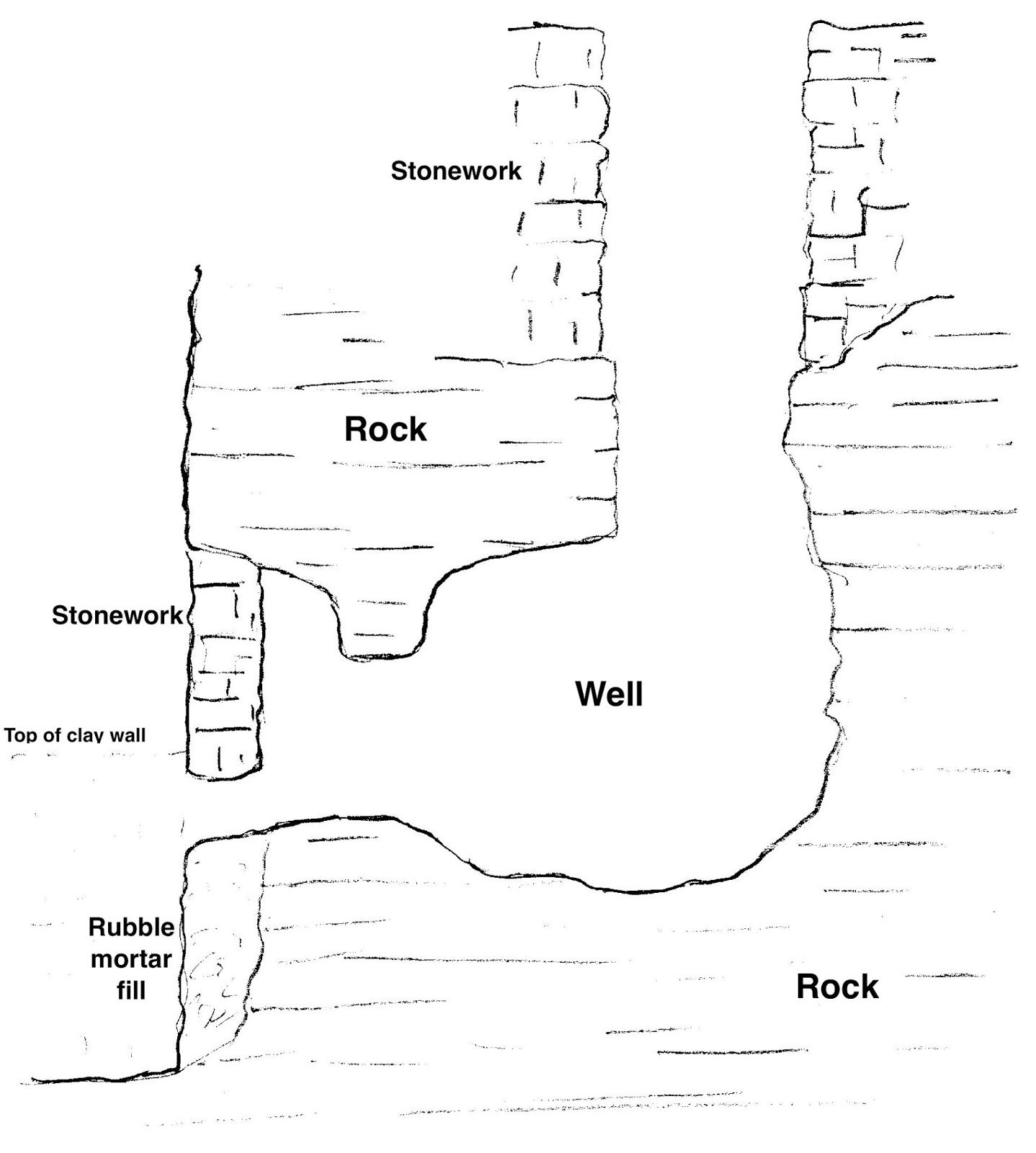
What is very surprising is that the lower part of the hole into the well is blocked by a rubble-mortar mix, which would mean that water would only flow into the well when it rose above this level, restricting the amount passing into the well.  This is very odd, since any castle under siege would need as much water as possible.  Odder still is the structure below the opening, to the left of the buckets.  It's made of blocks of stone, two of which came from the gate destroyed in 1644.  It's purpose is unexplained, but does suggest that alterations were made to the well some time in the latter part of the 17th or early 18th century.

I was invited to climb down into the well.  It was dark, dank and foul-smelling down there and, as there were three of us, crowded - but fascinating, mostly for all the questions it left unanswered.

This is a view taken from the bottom of the well looking towards the moat.  The well shaft is about 1.5m in diameter but opens into a small chamber at the bottom.  We're looking here at the tunnel which leads out of the bottom of the well to the moat, though it hasn't yet been fully cleared.  The hole that allowed water to enter is about half way down, set slightly to the left.

This is my interpretation of a cross section of the well, left being north.  The water in the moat at left would have risen to the top of the clay wall and then passed in to the bottom of the well - but the picture shows how little would have collected there.

 I was happy to leave the archaeologists to their work, but they weren't alone in the darkness as....

....there were plenty of large and evil-looking spiders to keep them company.

Tuesday, 10 September 2013

Progress Update

The scaffolding along the north wall is well advanced.  The picture shows how material from the car park can be moved straight on to the platform for distribution around the lower levels, but a second platform, on the third 'lift' (walkway), will be built so material can be loaded directly onto it.

Archaeologists Tom Addyman and Kenny Macfadyen of Addyman Archaeology arrived back on site today.  Kenny is in the moat where he will do a section through the stone and clay wall which holds back the water in the moat - he's standing on it.  The wall was considerably higher in its time, and was designed to channel water so it drained through the hole (just to the right of the surveying pole) into the bottom of the castle well.  Meanwhile, Tom is in the well carrying out a survey.

When they arrived they stopped to admire the hard work put in by the local amateurs who have been digging through the material brought out of the well.  We've already had it confirmed that the well was used as a toilet during the middle part of the 18th century, but Tom has now had a chance to study the claret bottles and pottery that have come out of it, and can date the deposit very precisely to the decade between 1755 and 1765.

The amateurs have been finding masses of broken glass, bits of pottery, bones from meals, leather (including the front of a boot) and some metal objects, but nothing very exciting, which made it all the more galling....

....when Kenny, within two minutes of arriving, picked a coin out of one of the piles which we'd already processed.

It was in some mortar and in too poor condition to be identified, but it's about the same size as the sixpenny piece which Ricky Clark found a week ago.

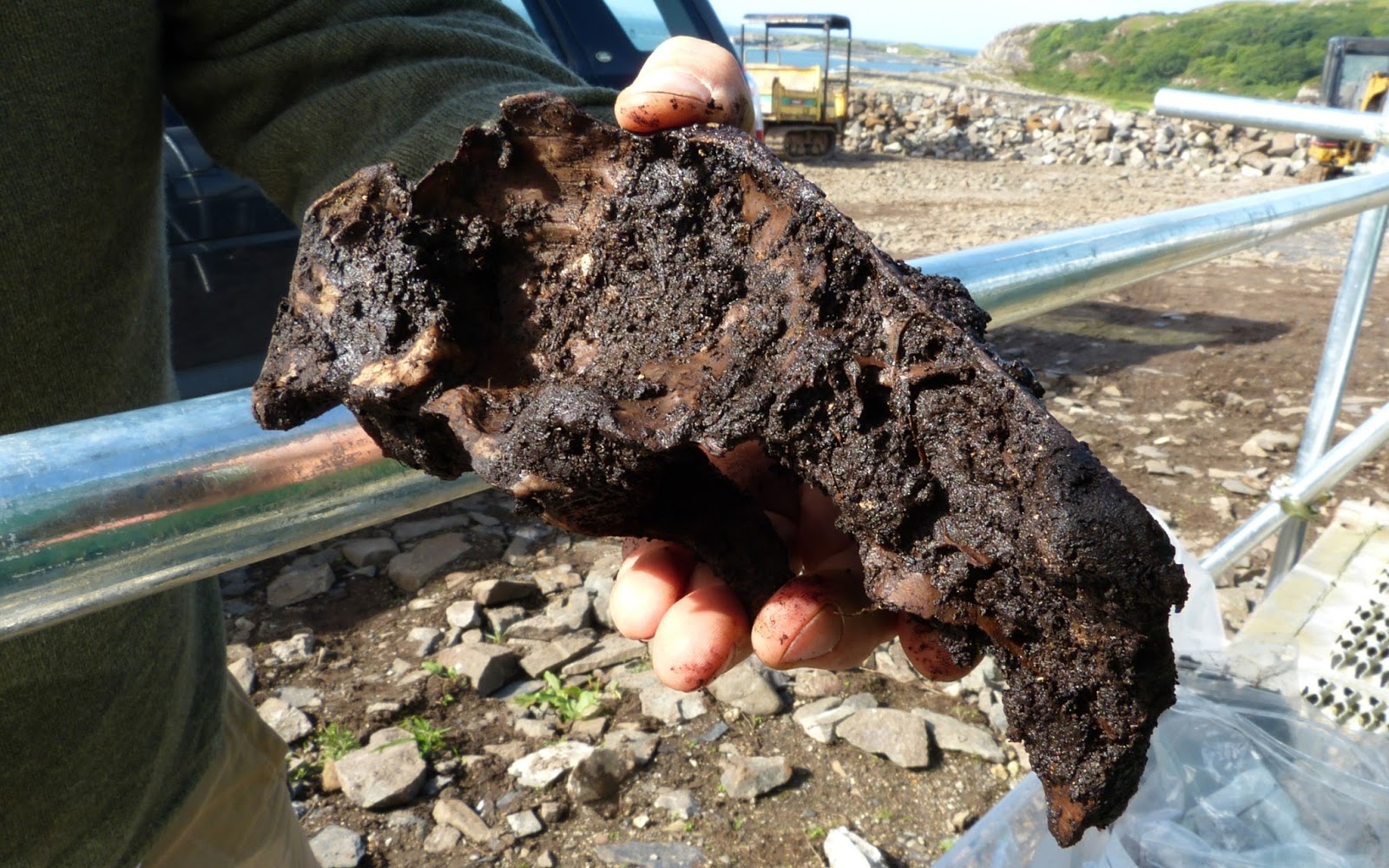
One interesting aspect of the well deposit is the presence of significant amounts of peat, some of it cut into neat blocks.  It's possible that these were thrown down into the well to absorb some of the smell, in the same way as wood shavings are added to a modern composting toilet.

Saturday, 7 September 2013

Scaffolding Wildlife

The eastern end of the moat is now clear of scaffolding, and the platform is in place to the right of the photo so it's now possible to walk straight onto it from the car park in front of the castle.  The scaffolders have been working hard to get this far: they worked until four this afternoon, Saturday, even though the stormy weather brought both heavy rain and, in the sultry conditions between downpours, a plague of Highland midges.

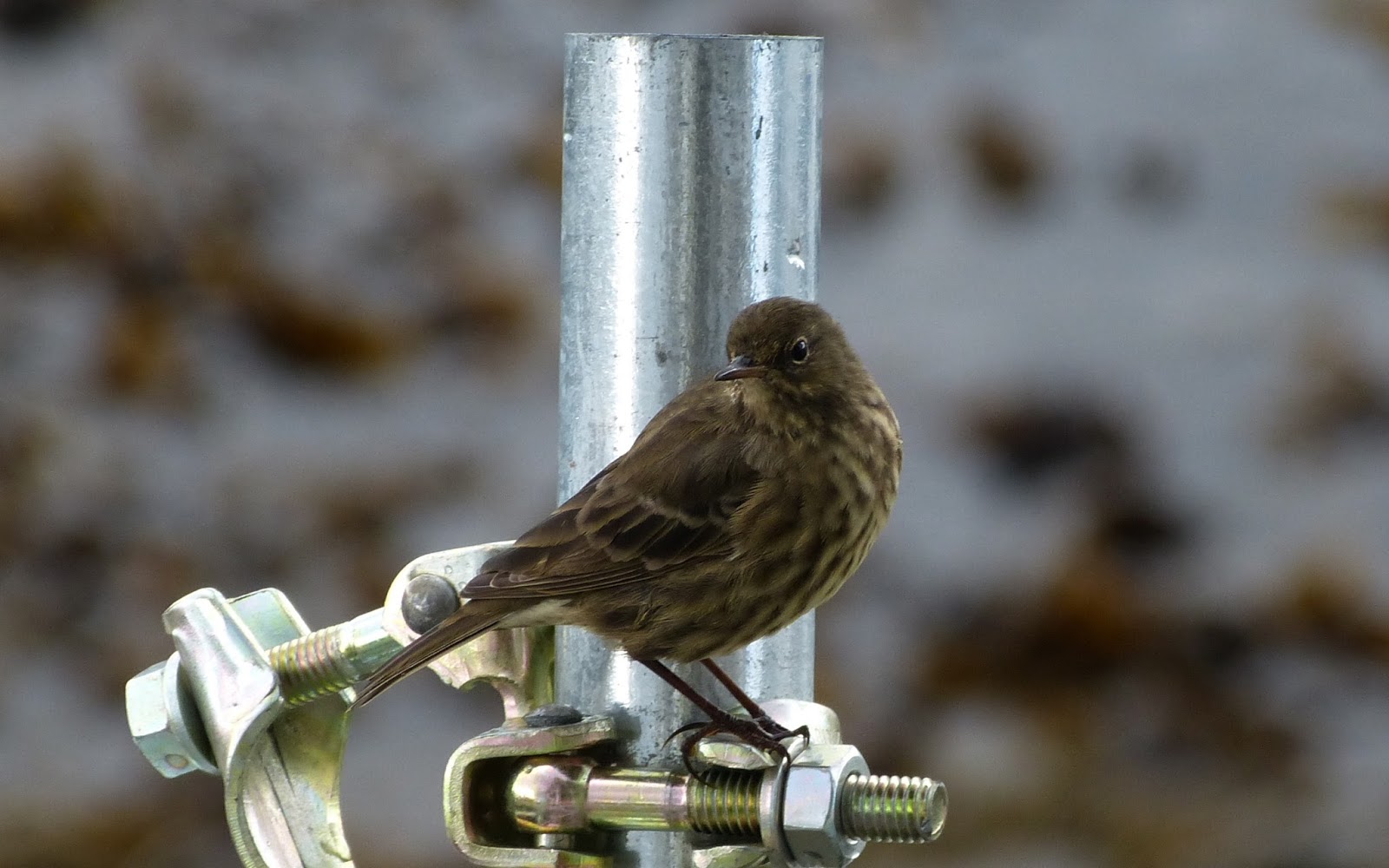
It's amazing how quickly the local wildlife have adapted to the new environment.  The small birds seem to love flying from one scaffolding perch to another.  This is a pied wagtail....

....and this looks is one of the pipits, perhaps a rock pipit.

Thursday, 5 September 2013

Scaffolding Meets Across North Wall

Scaffolder John Forsyth is back just in time to see an important milestone - the moment when his structure finally met across the north wall of the castle.

It's been a tricky piece of work as the left hand side of the scaffolding here has to be kept clear of the ground - in this case, the bottom of the moat - so that the boiler house for the castle's heating system can be installed.  So there are four sets of verticals which will shortly be removed: they're only there at present to enable the workmen to move across the face of the wall.

The scaffolding has been built out on the right to form the beginnings of a wide loading bay, but not at the level where the boarding currently is.

The loading bay will be at the level of the car park, so materials can be moved straight across onto the scaffolding structure.

Erecting the scaffolding over the moat has also taken time because of the uneven nature of the rock floor of the moat.  To make matters worse, we've had some 47mm of rain here in the last three days, and the moat had to be pumped out before they could set to work.

The scaffolding can now be seen rising above the level of the car park.  Very shortly, the north and northwest walls will be covered.  Completing the exterior scaffolding will take another two weeks or so, then there's scaffolding to be erected in the courtyard.

Tuesday, 3 September 2013

The Biggest Scaffolding Job in Scotland?

I was down at the site this morning mostly to admire the scaffolding.  It's an incredible job, rising like some sort of science fiction creeping vine, encircling and engulfing the castle walls.  This picture shows the west wall which now has four 'lifts' - that is, wooden walkways - out of the five that are planned.  The northwest and north walls are still almost bare of metalwork, though Stephen Holmes is working on the northwest wall, over the main gate, now.  These walls will need at least six lifts.

This view of the south wall also shows the other two walls where the scaffolding is almost complete....

....and these are the east and southeast walls.  The job's not being help by the weather, which was terrible yesterday, wet and windy - and this is a very exposed site - but the men worked through it.

Having admired the scaffolding a question came to mind.  When it's complete, will this be the biggest scaffolding job in Scotland?

Monday, 2 September 2013

Coin is Very Exciting Find


Ricky Clark, who works for Ardnamurchan Estate, was at the site on Friday using a metal detector to carry out a painstaking check of the material that came out of the moat.  While some sections of the moat were excavated by hand, much had to be removed by digger.  Ricky has already found cannon and musket balls, but his latest find is, if anything, even more exciting.

Ricky is busy adding to his previous finds - see earlier post here.  Yesterday he found a number of nails, what might have been - but probably wasn't - a door knocker, a lump of lead, and various other unidentifiable metallic objects, all of which will go away to be investigated.

But his best find was a coin.  Tom Addyman won't able to date Ricky's coin accurately until it has been conserved, but it's from the 16th or 17th centuries at the latest, and may be earlier - and is a significant find.  It's about the size of a 20p piece but much thinner, and made of copper alloy, though it may also contain silver.

One possibility is that it's a sixpence, or 'tanner' as it was known.  See the pictures of English sixpences here.

Sunday, 1 September 2013

The Archaeology of an 18th Century Household

Tom Addyman of Addyman Archaeology was back at Mingary for the meeting on Friday with Historic Scotland - which, to all accounts, went very well - so he had a chance to look at the finds which were made at the bottom of the well, which included the mass of broken wine bottle - see earlier post here.

He identified them as mallet bottles, which refers to the shape, and explained that, in the decades around 1750 they changed from shorter and squatter to taller and thinner - and we have some of both in the well, as well as some more unusual shapes.  Typically, they would have contained French claret.

Along with the bottles the well contained broken crockery which included soup bowls (above), plates, saucers, and a jug.  Most is salt-glazed earthenware and all dates from the same period, 1740-1760, when it was produced both in England and Scotland in large amounts.

Another interesting piece is what may be part of a chamber pot.  All these, along with some finds of porcelain, are typical of the household goods of a middle-class gentleman, but the story at Mingary may be a little more complicated.

After 1745, when Bonnie Prince Charlie landed at Glenfinnan, Mingary was occupied by Donald Campbell of Auchindoun, the local factor for the Duke of Argyll.  By 1746 the garrison had risen to fifty-nine officers and men who, after Culloden, occupied themselves by harrying the properties of local Jacobite landowners.  It seems very possibly therefore that this material belonged to the officers who would have lived in the north range and, apparently, used the well as both a toilet and a rubbish dump.

In view of this, a find made by Tom himself is particularly interesting.  It's a glass bead or 'jewel' which would not have adorned an officer's uniform, so it suggests that the officers entertained local ladies.  It may have been part of a brooch or ring, or been attached to an item of clothing.

The huge collection of bones we're finding is also giving us an idea of what the occupants of the castle ate.  This is half a sheep's skull, chopped lengthwise down the middle, and indicates that sheep's brains were on the menu.  Perhaps it was what the officers' ladies enjoyed.