The Mingary Castle restoration blog was written by Jon Haylett, who lives in the local village of Kilchoan. Now that restoration is almost complete Holly and Chris Bull will take over to report on bringing the Castle back to life.

Saturday, 10 August 2013

Two Exciting Finds Today

Tom Addyman of Addyman Archaeology has been on site for the last couple of days and, with his arrival, the finds have suddenly started again.  The first is a cannonball, found at the eastern end of the moat.  It's probably in pieces because it hit the castle wall and fractured before falling into the moat where time and weathering have broken it into four pieces.

The second find is a musket ball.  It's in immaculate condition, and very heavy, probably because it has a high lead content.  It too came out of the moat, close to where the cannonball was found.  It's about 20mm in diameter, but it's slightly flattened on one side, probably from contact with a solid surface.

The archaeologists are back excavating in the moat but we don't yet know the extent that they will be able to open up.  More news, hopefully, next week.

Many thanks to Ricky Clark for the photos.

Thursday, 8 August 2013

Scaffolders Start Upper Level

Sometimes, progress on site does seem desperately slow.  The cable for the electricity has been down for ages but the local electricity board has only just got the transformer in place on its pole.  The next stage is to get it connected to the mains.  On the services side there has been progress elsewhere.  With the site offices now in use, they are being hooked up to the septic tank, and water is now available on site.

Scaffolding poles are still arriving, the latest batch being ones that have been cut to the lengths required for this job in Glasgow.

John Forsyth, the scaffolder, would have liked to carry the lower level of the scaffolding round the front of the castle to make the whole structure stable but, as can be seen from this picture, this hasn't been possible because everyone is still waiting for a decision on further excavation of the moat.  There is talk of a trench being sunk at the western end, to the right in this picture, by the entrance where the drawbridge used to be.

Instead, the scaffolders, who are making very rapid progress with their side of the job, are starting the upper level above the water gate on the south side.  This view is from the east, while....

....looking from the west, we can see that they are starting to fit the 40cm beams into place which will bring the upper level of the structure against the castle's walls.

This picture was taken from the castle entrance, and shows how John and Stephen Holmes are building outwards so they can join up with the lower level of the west side scaffold.  John certainly has a fine view across the Sound of Mull to Tobermory Bay.  The larger ship is CalMac's Clansman, the smaller is the Loch Linnhe, the local Calmac ferry from Kilchoan to Tobermory.

Some of the joints, where several poles meet, are really quite artistic.  At least now the mass of materials they need can be delivered to them from the castle's sea gate, rather than taking it down onto the shore and then lifting it up into the structure.

Tuesday, 6 August 2013

Scaffolding Work Progresses

I was down at the castle in mixed weather this morning, bright intervals alternating with sudden showers coming in across the Sound of Mull.  The main purpose of the visit was to check on progress with the scaffolding.

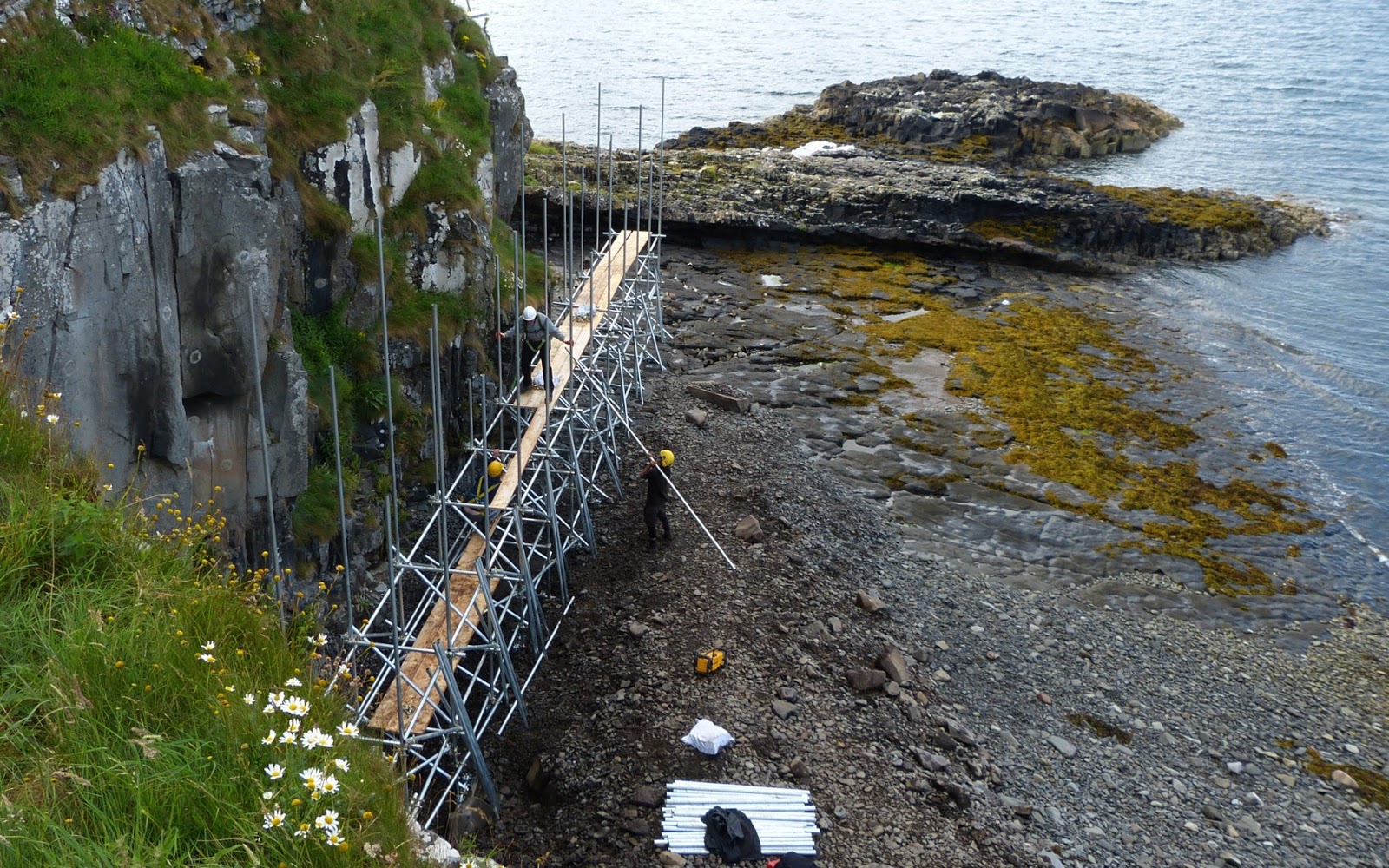
The two scaffolders, John Forsyth and Stephen Holmes, really have cracked on with the job, the lower section of scaffolding being almost complete along the base of the west wall.  John and Stephen are working with five of John-Paul Ashley's men....

....some of whom are helping to erect the structure itself - picture shows Howard drilling holes into rock for the bolts which fix the base of the scaffolding, while the others are....


....moving the mass of materials from the car park, over a high drystone wall, and down a steep and slippery slope to the beach.  So far the scaffolders haven't found themselves short of anything, but they are having to vary the design of the structure quite a lot as they find difficulties along the rock face.

One of the archeologists from Addyman Archaeology is back on site.  Kenny Macfadyen is filling in some gaps in the ground plans of the castle.  He's seen here wedged into the narrow passage that leads to the western garderobe: to the immediate right of where he's standing is a hole in the ground which leads down to the dungeon.

Kenny's waiting to start work on detailed elevational drawings of the walls which are being made from photos.  These pictures have been orthographically scaled and rectified, and digital drawings are currently being made, by hand, in India.  Once back, Kenny will be annotating them to create a detailed record: for example, one of the things he will be marking is the breaks in construction, which are best seen running across the north wall.

The next stage for the scaffolders would normally be to complete the structure round the north, moat side of the building - round to the right in this picture - but whether they will be able to do this depends on a decision that's waiting to be made on whether to excavate at the western end of the moat, next to the castle entrance.

Friday, 2 August 2013

The Scaffold Structure

Erecting the scaffolding on a job like this is both a science and a skill.  The science goes into the design of the latticework, since it is going to have to withstand both the stresses of men and materials moving across it over the next two years, and the battering it will receive from the Scottish west coast's fearsome elements.

In the site office, which is now in a portkabin in the car park beside the castle, builder John-Paul Ashley showed me the several pages of drawings that have been put together by scaffold design consultants Scaftec Ltd.  While scaffolder John Forsyth will follow these drawings as far as he can, there will be points where he has to vary from them - but any variation has to take into account the safety of users.

The job is complicated by the fact that, along three of the six walls, the scaffolding has to stand on the shore.

I drew this sketch with John's help to illustrate an additional problem - that the base of the scaffolding is starting well away from the castle wall, so the structure has to be let in so it rises some 20" away from the stone wall.  Note how, in two places, beach shingle has had to be cleared to allow the scaffolding to stand on rock.

The  lower section of scaffolding, which supports the scaffolding against the castle walls, has cross-pieces every 1100mm.  The higher section has them wider apart, at 2000mm, giving comfortable working room.  The walkways, which are of timber planking, are 4ft wide, and each level of walkway is accessed from the next by ladder.  Once the whole thing is up, we'll be able to step out onto it from beside the castle entrance.

Most of the lowest poles sit on the eroded limestone wave cut platform.  They are bolted to it using 6" Apollo M12 anchor bolts.  Some of the inner ones, however, sit on a step of the limestone which is rather more friable.

As John Forsyth and Stephen Holmes built the scaffolding upwards, they also bolted various levels to the granophyre rock wall, the very slabs that Vertical Technology had pinned back to prevent them falling outwards.  In fact, they've put more bolts in than Scaftec required.

As the scaffold rises above 4m, so the work becomes increasingly dangerous.  The health and safety of workers on the site is paramount, so John and Stephen (seen here) have to wear safety harnesses which attach them to the structure.

Watching all this going on, one question jumps to mind.  How on earth did the original builders of these great walls manage it?  Did they have a 13th century equivalent of scaffolding, and a 13th century John Forsyth?

Tuesday, 30 July 2013

Starting the Scaffolding

When I visited the site last Thursday the first scaffolding was beginning to appear at the base of the sea gate wall.  I didn't have time to have a look at it but took this picture to show the level which is reached by a high tide - the one on Thursday was just past its peak, was unusually high, and unusually calm.

By this morning the scaffolders were working their way around to the west wall, and beginning to find solutions to the multiple problems of erecting scaffolding on the Mingary Castle site.  As with the sea gate wall, they were able to put the base of the scaffolding straight onto the limestone of the wave cut platform, but....

....this meant that John-Paul Ashley, the main contractor, had had to dig out the single beach which covered it to expose the rock.

The contract to erect the scaffolding has gone to JRandM Scaffolding - they have a Facebook page here.  John-Paul of builders Ashley Thompson has worked with John Forsyth (above) and says of his scaffolding skills, 'there's nothing he can't do'.  J-P recalled a complex job they had in London where 15 metre-high scaffolding had to go around a building on a very restricted site, round a chimney and across a conservatory.

On this job John, centre, is helped by Stephen Holmes (right).  John is from Bradford, Stephen from Leeds.  John-Paul's men are carrying all the poles and fittings from the car park down to the beach - that's Roger Piccolo on the left, now one of J-P's men though he originally came to the site working for Vertical Technology - he liked the area so much he chose to stay.

This picture shows progress so far.  Bearing in mind that the scaffolding will cover the whole of the outside of the castle, John Forsyth estimates that it will take about eight weeks to erect, if all goes well, and will be in place for upwards of two years.  When I asked him whether he was confident it would stand the gales and fierce seas we have during the worst winter months, he nodded, and took me on a tour to demonstrate how the structure was being built - the subject of the next blog.

Monday, 29 July 2013

Arrowhead Found


There was huge excitement on site on Thursday with the discovery of an arrowhead.  I use the word 'discovery' carefully - the arrowhead had, in fact, been dug out of the rubble in the castle courtyard some weeks previously, the finder being Dave Henderson, but no-one recognised it until the artefacts were being washed and cleaned ready to go back to Addyman Archaeology's offices.

The delay in announcing this stunning find was to give Ross Cameron of Addyman Archaeology, who is an expert on Scottish west coast castles, a chance to do a little research.  He writes, "We cannot fit the shape of the arrowhead into any known or accepted typology that we can lay our hands on, but when it goes to a specialist, I am sure they will give us a date.  What I do have is a couple of quotes:

"Scottish Arms and Armour by Fergus Cannan (Shire Publications 2009), says, 'George Buchanan (in his History of Scotland completed in c.1579 and published in 1582) observes that Highlanders fire arrows ‘for the most part hooked, with a barble on either side, which once entered within the body, cannot be drawne forth againe, unless the wounde be made wider.’

"Cannan goes onto say, ‘These sound like barbed hunting arrowsheads pressed into battlefield use – John Taylor in his Pennylesse Pilgrimage (1618) in fact says of Highlanders that 'their weapons are long bowes and forked arrows… with these armes I found many of them armed for the hunting.'’

"Thus it is clear that the arrowhead could easily be in use in the 17th century at the time of the Wars of the Three Kingdoms (ie MacColla’s siege and subsequent siege by Campbell). The context is not particularly helpful, as it lies just underneath the topsoil. It could also be a hunting arrowhead, unrelated to warfare, although it is tempting to think otherwise.

"None of us on site have ever found an iron arrowhead before, so we are all tremendously excited about it."

Tuesday, 23 July 2013

What Happens to the Finds

Last week, in very inclement weather, Philippo Peritone and Lara Ferrarotti had the unenviable task of cleaning out the bottom of the excavation in the moat.  It was miserable work, ladling the mud slurry into buckets while, at the same time, trying to check for any artefacts, then carrying each bucket to the top of the slope to empty it.

Once almost down to bedrock, they were able to start using the water which is, at last, on site, to work through the crevices in the rock, in the hope of finding what should have been some of the oldest material.

The basement rock looks so fresh it might have been cut yesterday - in fact, it might as well have been, because....

 ....they found very little to excite them.

These finds, being from one 'context', were placed in a plastic bag and carefully labelled with a find number and the number of the context, along with the date and the names of the archaeologists who found them.

When I went down to the site this morning, Kenny Macfadyen had returned to the castle after a few weeks away, along with Ross Cameron.  Kenny was in the moat making careful records - along the lines I described in yesterday's post.  He's seen sitting on the low, clay-lined wall that runs at an angle across the eastern end of the moat, a feature which has yet to be explained.

It being a lovely morning, Ross put me to work on the next stage of dealing with the finds.  Each plastic bag is emptied into a tray, and then every find is very carefully washed before being placed on a layer of newspaper in a clean tray to dry.  Conditions were ideal: the finds dried quickly in the sun and light breeze, and I worked on my suntan.  The only difficult part of the job was making 100% sure that the finds didn't get muddled, so the original plastic bag was pushed under the newspaper in the tray.

This is a typical tray, in this case full of animal teeth and bones - presumably from meals once eaten in the castle.  When dry, they are placed in a clean bag which is carefully numbered; the bags then go away to experts.  This collection of bones will go to a bone specialist who will know which animal each came from, and will be on the lookout for things like butchery cuts into the bone - we think the large bone in the middle may show some.